How Does an Electric Pizza Oven Work?
An electric pizza oven works by pushing current through heating elements above and below a pizza stone, so the oven reaches 700°F to 800°F in a small chamber. The hot stone crisps the base while radiant heat from the top browns the cheese, which is why a pizza bakes in 4 to 6 minutes instead of 15 to 20.
On this page (10 sections)
- What heats the pizza inside an electric pizza oven?
- Why does the pizza stone matter so much?
- How does heat move from the element to the crust?
- How hot does an electric pizza oven get?
- What do the controls actually change?
- Why is it faster than a regular oven?
- What do you need to run one at home?
- Which electric pizza oven fits your kitchen?
- What an electric pizza oven cannot do
- The short answer on electric pizza oven operation
An electric pizza oven turns wall power into focused, high heat. Current flows through metal heating elements at the top and bottom, the pizza stone sitting in the middle soaks up that heat, and a pizza bakes in minutes.
That is the short version of how does an electric pizza oven work; the details below explain each part.
The main difference from your kitchen oven is scale and temperature. A standard oven spreads heat through a large cavity and rarely passes 450°F.
A countertop electric pizza oven keeps the heat close and pushes the stone to 700°F or higher, so the crust sets fast and the cheese melts before the dough dries out.
What heats the pizza inside an electric pizza oven?
Resistance heating elements do the work, wired above and below the pizza. Each element is a coil that gets hot when current passes through it, the same basic part as the bake and broil elements in a full-size oven.
Most countertop models split those elements into two zones. The Piezano runs separate knobs for the upper and lower elements, so you can brown the top while the base crisps at a different rate.
The Chefman pushes both elements from 300°F to 800°F and keeps them hot between pies.
Because the chamber is small, the elements are only inches from the food. That short distance is why heat reaches the dough quickly and why a 12-inch pizza can go from raw to bubbly in under 6 minutes.
Why does the pizza stone matter so much?
The stone is where the crisp base comes from. Ceramic or cordierite holds heat and releases it straight into the dough, so moisture leaves the bottom quickly instead of steaming it soft.
A cold stone gives you a pale, floppy crust no matter how hot the air is. That is why brands ship one with the oven: Cuisinart includes a 12.5-inch stone, Chefman includes a stone and peel, and the Piezano uses a removable 12-inch ceramic stone that lifts out for cleaning.
The removable design helps more than it sounds. You scrape and rinse a loose stone, then let it dry fully before it goes back in.
A fixed stone is harder to keep clean between pizza nights.
How does heat move from the element to the crust?
Radiant heat from the top, stored heat from the stone, and hot air around the edges all hit the pizza at once. Each one changes the bake in a different way.
The top element browns the cheese and blisters the surface. The stone sets the bottom.
Air in the small chamber cooks the rim, which is why a thick edge puffs while the middle stays flat.
That balance is why the Piezano's dual knobs matter. If the top browns before the base crisps, you turn the top down.
If the base is done and the cheese is pale, you raise the upper element. On a single-element oven you cannot make that correction.
How hot does an electric pizza oven get?
Countertop electric models reach 700°F to 800°F, far above a normal oven. The exact top end depends on the model, and it shapes which pizza styles you can bake well.
The Chefman reaches 800°F and offers five touchscreen presets: Neapolitan, New York, thin-crust, pan, and frozen. The Piezano also hits 800°F and advertises a fresh 12-inch pizza in under 6 minutes.
The Cuisinart ranges from 350°F to 700°F and covers Neapolitan plus deep dish, Detroit style, and New York style.
Lower settings are not a weakness. Pan and deep-dish pizzas need longer, gentler heat than a thin Neapolitan, and a 350°F floor lets you bake them without burning the base.
What do the controls actually change?
Controls set element power, and that sets how the top and bottom of the pie brown. Temperature alone does not tell the full story.
A simple dial oven gives you one heat level for the whole chamber. A dual-knob design like the Piezano lets you treat the top and bottom as separate ovens.
A touchscreen like the Chefman's does the same job through presets, picking a heat profile for the style you chose.
Two more features earn their place. The Cuisinart has a large viewing window and interior light, so you check browning without dropping heat.
The Piezano uses a see-through window plus a built-in thermometer for the same reason. Opening the door mid-bake costs you degrees you spent 20 minutes building.
Why is it faster than a regular oven?
A standard oven needs 15 to 20 minutes at about 450°F; an electric pizza oven needs 4 to 6 minutes at a much higher temperature. Extra heat is only part of it.
The small chamber means less air to heat and less heat lost when you open the door. The stone also sits closer to the food, so its stored energy reaches the dough directly.
And most electric pizza ovens keep their heat between pies, so a second pizza starts on a hot stone in the Chefman and Piezano.
Preheat is the honest cost. The Cuisinart takes 20 to 30 minutes to reach its top range, and the stone needs that time to charge.
Once it is hot, the baking itself is quick.
What do you need to run one at home?
You need a standard 120V outlet and enough counter space, plus a little clearance for the cabinet. These ovens are built to be plugged in and switched on, with no gas line or assembly.
Power draw matters if your kitchen is busy. The Piezano uses 1,200 watts, and the Chefman draws 1,700 watts.
A 1,700-watt oven on a shared line with a kettle or microwave can trip a breaker, so give it its own circuit when you can.
Footprint is the other limit. The Cuisinart measures 19 by 17.5 by 11 inches, the Chefman 17 by 18.7 by 10.9 inches, and the Piezano 13.8 by 13.6 by 6.5 inches.
Check the space under your cabinets before you buy; see how to use an electric pizza oven for the full first-bake routine.
Which electric pizza oven fits your kitchen?
The Piezano suits small kitchens and quick weeknight pies, the Chefman suits preset cooks who want maximum heat, and the Cuisinart suits anyone baking several styles. Each one solves a different part of the problem.
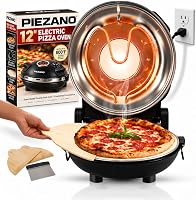
Piezano 12 inch electric
The Piezano is the small, light option. At 800°F it bakes a 12-inch stone pizza in under 6 minutes, and the dual knobs let you crisp the base and brown the top separately.
It also brings two wooden peels and a scraper in the box.
Chefman indoor pizza oven
The Chefman is the heat-first choice. Its elements run from 300°F to 800°F, the touchscreen carries five presets, and a double-paned window helps hold heat for back-to-back pies.
A stone and peel come included.
Cuisinart indoor pizza oven
The Cuisinart is the all-rounder. It runs 350°F to 700°F, bakes a 12-inch Neapolitan in 5 minutes or less, and includes a deep-dish pan, a peel, and a 12.5-inch stone for other styles.
If you are still deciding between styles, our guide to the best budget pizza ovens narrows the field by price, and the best propane pizza ovens covers the gas alternative.
What an electric pizza oven cannot do
It will not match a wood-fired oven's char, and it will not fit a 16-inch pie. A countertop electric chamber is built around 12-inch pizzas, which is the size every model here bakes.
The flame flavor from wood or gas comes from combustion, and electric heat has no flame. You get an even, controllable bake instead of a smoky one.
For many home cooks that trade is worth it, because the result is repeatable.
Noise and warm-up are the small costs. Elements heat silently, but the cooling fans on some models run during the bake, and the preheat window is real.
If you want open-fire flavor, look at a pizza oven for grill setup instead. An electric oven wins on convenience and control, not on smoke.
The short answer on electric pizza oven operation
How does an electric pizza oven work? Heating elements above and below a stone convert electricity into intense heat, the stone transfers that heat to the dough, and a small chamber keeps it trapped.
The result is a crisp base and browned top in minutes.
Choose the Piezano if counter space is tight and you want dual heat control. Choose the Chefman if you want 800°F and presets to remove the guesswork.
Choose the Cuisinart if you bake deep dish and New York style as often as Neapolitan.
Whichever you pick, give the stone its full preheat and keep the door shut while it bakes. That is where most of the quality in an electric pizza oven comes from.
Frequently asked questions
Can an electric pizza oven run on a normal kitchen outlet?
Yes. Countertop models draw 1,200 to 1,700 watts and plug into a standard 120V outlet.
Run a heavy one on its own circuit if you can, since a shared kitchen line with a fridge or microwave may trip.
Does an electric pizza oven need to preheat?
Yes, and the stone matters more than the air. The Cuisinart heats to its top range in 20 to 30 minutes, and the stone needs that time to store heat so the first pie gets a crisp base rather than a pale one.
Why does my electric oven pizza come out pale on top?
The top element is doing less work than the stone. Raise the upper heat setting, or finish with the upper element turned up for the last minute so the cheese browns before the base overbakes.
Is an electric pizza oven the same as a regular kitchen oven?
No. A standard oven tops out near 450°F in a big cavity.
An electric pizza oven runs to 700°F or 800°F in a small chamber that sits inches from the stone, which is the whole reason it cooks so fast.